
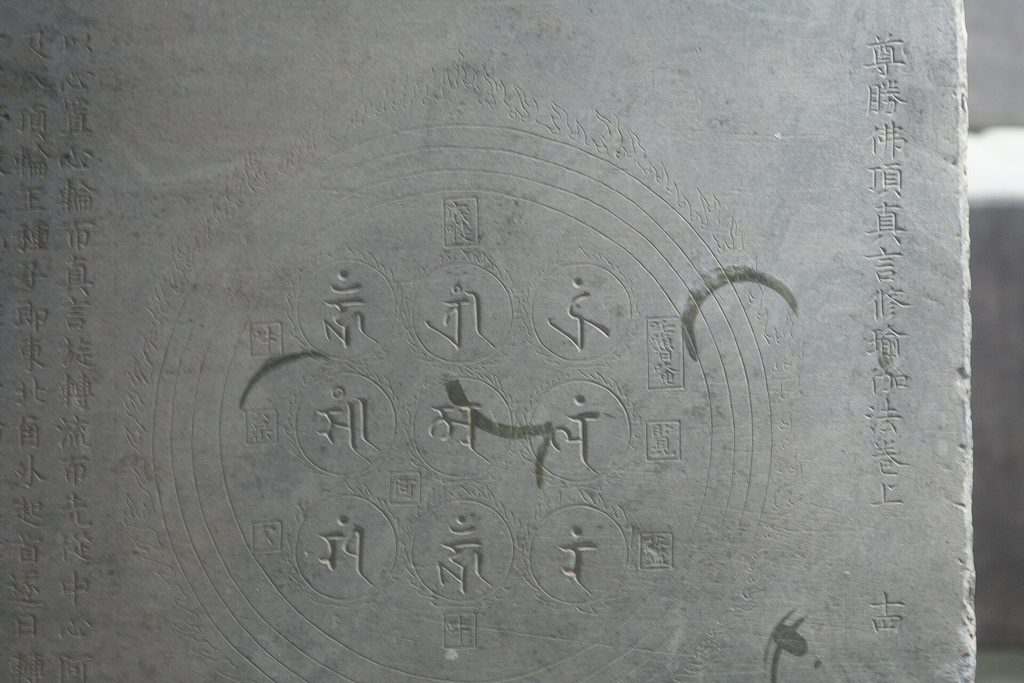
The year was 577CE. The Emperor Wu of the Northern Zhou was coming closer to Fangshan. They were not Buddhists. In fact, they were everything but Buddhist. The Jiande Persecutions1 since 574CE had viciously destroyed monasteries and killed monastics, or stripped them of their robes. Should they rule China, the Dharma would be in danger. The books, made of paper, ink and wood… they would destroy them, just as they would eventually destroy some 40,000 monasteries. The precious Dhamma, the Dhamma that taught the way out of suffering, would be lost to China, forever.
Venerable Jingwan, in his room in Yunju Temple, was unable to sleep at night. He feared that Mofa, the Dark Age had begun2. He meditated. What could be done? How could the Dhamma not be destroyed? How could it be preserved that no invading army, no despotic Emperor could ever destroy the teaching that had changed his life, and so many millions of others since Buddhism arrived in China? How would the Dhamma be preserved for the benefit of humanity, for years…no…millenia to follow?
He wrote in his diary:
“The True Law and the Counterfeit Law, too, have been lost in the depths, all living beings are heavily stained and faithful hearts are no more… I fear for the day when the scriptures with disintegrate and dissolve, for paper and palm leaves are hard to maintain for a long period of time. Whenever I ponder these matters my tears flow in compassion and sorrow. In order to preserve the True Law, I, Jingwan, have led my followers to this mountain ridge to engrave in stone the sutras in the twelve divisions”.3
Stone
It could not be burnt. It could not be picked up and cast into the rivers.
He would carve the words of the Buddha onto the walls of the cave he was living in.
And so begun the project that would last 1,039 years. In 605CE, Ven. Jingwan embarked on the impossible task of chiseling the 84,000 teachings of the Buddha onto stone.
He worked day and night, as did his small band of followers. They began boring out the mountain caves, polishing the walls then chiseling. One character at a time, one sentence at time, each sutta was painstakingly engraved to withstand the ravages of time.
His heroic resolve didn’t go unnoticed. Fortunately the Northern Zhou were halted and China was united under the Sui Dynasty. The brother of the Empress, a devout Buddhist, met Jingwan and, deeply impressed, he brought it to the attention of his sister, Sui Empress Xiao4.
Venerable Jingwan’s solo undertaking suddenly scaled up in scope and significance with royal backing and an explosion of inspired financial support. By the time he passed away in 639CE, he had completed at least 10 major canonical titles, carved onto multi-volume portable slabs to stack inside newer caves. He left behind a highly organised monastic community, a functioning rock-quarrying apparatus and a system of carving standards which his successor Abbot Xuandao seamlessly continued5.
His crowning achievement was carving and embedded 147 stone slabs into the bedrock of Leiyin Cave containing 19 fundamental Buddhist texts including the Lotus Sutra, Vimalakirta Sutra and Diamond Sutra. Further, in 1981, a secret relic vault was unearthed. Nested inside a jewel-encrusted vessel under a sub-floor of Leyin cave, archeologists discovered two corn-shaped red-flesh Buddha body relics. This had been the spiritual ‘heart’ of the mountain complex6.
For the next 1,039 years, a project spanning six dynasties, the mammoth task of committing the word of the Buddha onto stone was taken up, one dynasty after another. Venerable Jingwan had laid the foundation for the 14,278 slab library it would become.
The next 1000 years7
While the Sui Dynasty established the groundwork for the Fangshan Stone Sutra project and Buddhism as a whole to become a state religion, it was during the Tang Dynasty (618 – 907), the Golden Age of Buddhism in China, that the project received the most patronage. Not just with state wealth, political integration and artistic sponsorship, the Empress Wu Zetian provided the official imperial Master Copy of the Tripitaka (Kai Yuan Da Zang) to guarantee textual perfection.
The Liao Dynasty (916 – 1125) was the most obsessively supportive. During that time, over 10,000 stone slabs were produced, completely out-carving all the other Dynasties combined. It was due to their efforts that the Khitan Tripitaka, a historically legendary woodblock edition of the entire Tripitaka, that was thought to be lost, was rediscovered. It had been carved onto the Fangshan Stone Slabs. The Khitan Tripitaka had preserved commentaries of the Avatamsaka Sutra, some rare Tantric teachings and pristine versions of the Abidhamma that were missing in the commonly used Taisho Tripitaka. When the Tripitaka Koreana was compiled in the 13th Century, the Khitan Tripitaka was used to correct hundreds of errors in their own volumes8.
The last slabs were placed in their chambers in 1644. Its final phase was marked by a deliberate effort to achieve completeness rather than abandonment of the project. It was during the Wanli era of the Ming Dynasty, that court officials realised that the project had been running for over a thousand years. Scholars systematically compared the existing stone slabs against the printed Ming Imperial Tripitaka (Northern Zang). Scribes and carvers were hired to create the final set of stone slabs to ‘plug in’ the missing gaps.
After 1,039 years, Venerable Jingwan’s mission was complete. The collection totals 14,278 carved stone slabs, 1,122 individual sutras and over 35 million characters9.
Digitizing the Fangshan Stone Sutras10
Today this precious resource is available to the world without having to open sealed cave vaults. Lighting matrix data acquisition along with AI algorithms are being used to re-build lost fragments and photograph the collection. Textual transcriptions have been gradually integrated into global Buddhist databases such as CBETA (Chinese Buddhist Electronic Text Association) so that this precious resource is available to the world.
Yunju Temple and Leyin Cave on Shijing Mountain11
The Yunju Temple, 75 kilometres southwest of Beijing, along with a network of nine caves, including Leiyin Cave, in nearby Shijing Mountain, houses the legendary Stone Sutras. Some of these historical scripture caves were hand-dug by Venerable Jingwan. It is a popular destination for locals and visitors alike. Modern Chinese youth turn to temples like Yunju —often described jokingly as choosing “incense over ambition”—to seek psychological relief from competitive corporate life, pray for career or health outcomes, and purchase blessed bead bracelets (shouchuan).
One can appreciate the magnitude of the project through samples of stone slabs that are on display in the many halls, gardens and stupas of Yunju’s massive temple complex.
One kilometre east of Yunju Temple, on Shijing Mountain, is Leyin Cave (No. 5), the only one of nine caves dug into Shijing Mountain that is open to the public. The rest remain closed by boulders with this direction from Venerable Jingwan:
“This set of stone scriptures has been prepared for a time in the future when calamity will befall the Buddhist Law. As long as there are still scriptures in this world, do not open [this cave].”12
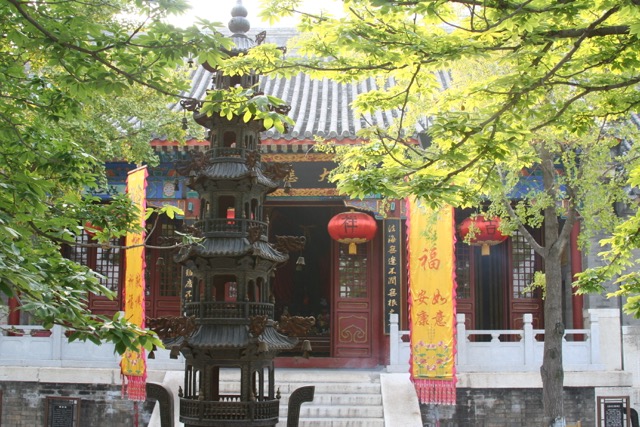
Guanyin Hall of the Yunju Temple
Images By Alexamies – Self-photographed, CC BY-SA 3.0, https://commons.wikimedia.org/w/index.php?curid=22209628
References
1 https://baike.baidu.com/en/item/Northern%20Zhou/17972
2 https://en.wikipedia.org/wiki/Yunju_Temple
3 https://en.wikipedia.org/wiki/Jingwan
4 https://www.researchgate.net/publication/411197946_The_economic_religious_and_political_implications_of_Empress_Xiao_of_the_Sui_Dynasty_and_her_younger_brother_sponsoring_the_stone_sutra_carving_led_by_Jingwan
5 https://en.people.cn/n3/2025/0926/c90000-20371317.html
6 https://en.wikipedia.org/wiki/Jingwan
7 https://en.wikipedia.org/wiki/Yunju_Temple
8 https://en.wikipedia.org/wiki/Tripitaka_Koreana
9 https://en.wikipedia.org/wiki/Yunju_Temple
10 https://www.globaltimes.cn/page/202512/1351020.shtml
11 https://baike.baidu.com/en/item/Shijing%20Mountain/889907
12 https://www.google.com.au/books/edition/Building_a_Sacred_Mountain/M9oTCgAAQBAJ?hl=en Page 66
Researched and written by Ayya Upekka